
Have you heard of a ticker called FIX? Its real name is Comfort Systems USA. While most people have been focused on Nvidia, this quiet industrial company has actually done even better over the past five years.
A $10,000 investment in FIX grew to about $180,000, compared to about $150,000 for Nvidia. It’s a good reminder that you don’t always need the most popular stock to get great returns — sometimes the steady, boring ones win.
The performance discussed reflects only the past five years, which is a specific time period and may not represent results over longer or shorter horizons. Performance can vary significantly depending on the timeframe measured, and different market cycles can produce very different outcomes. Past performance is not indicative of future results, and there is no guarantee that similar returns will continue going forward.
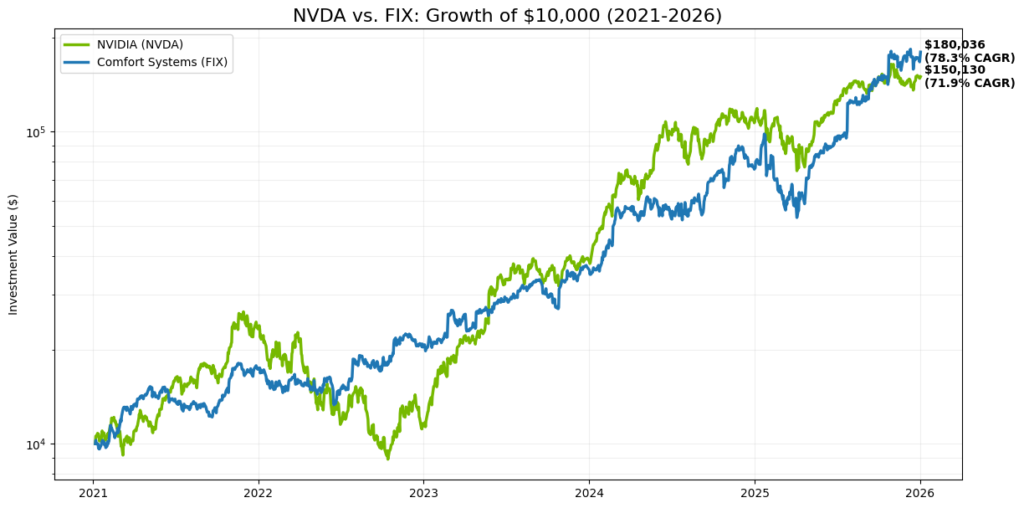
This chart compares the growth of a $10,000 investment in Nvidia (NVDA) versus Comfort Systems (FIX) from 2021 to 2026, and it tells a story most investors wouldn’t expect.
Key takeaways from the CHART
- Both stocks massively outperformed the market, turning $10,000 into six-figure outcomes.
- FIX ultimately wins:
- FIX: ~$180,036 (78.3% CAGR)
- NVDA: ~$150,130 (71.9% CAGR)
Performance Summary (2021–2026)
| Ticker | Start Price (2021) | End Price (2026) | Multiplier | CAGR (%) | Final Value ($) |
|---|---|---|---|---|---|
| FIX | 55.75 | 1,003.64 | 18.00 | 78.27 | 180,036.34 |
| NVDA | 12.58 | 188.85 | 15.01 | 71.91 | 150,129.69 |
This chart compares the growth of a $10,000 investment in Nvidia (NVDA) versus Comfort Systems (FIX) from 2021 to
Company Overview
Comfort Systems USA (FIX) — in one compact explanation:
Comfort Systems USA installs, upgrades, and maintains the essential systems that make large buildings work. Its core business is HVAC, plus electrical, plumbing, piping, and building automation for commercial and industrial properties.
They work on offices, hospitals, schools, factories, warehouses, and data centers, earning money from both new construction projects and ongoing maintenance contracts. The company also grows by acquiring smaller regional contractors, giving it nationwide scale.
In short:
FIX is a behind-the-scenes infrastructure company that builds and services the climate, power, and mechanical systems every large building depends on — steady, necessary, and hard to replace.
The Infrastructure Alpha: FIX vs. S&P 500 (2021–2026)
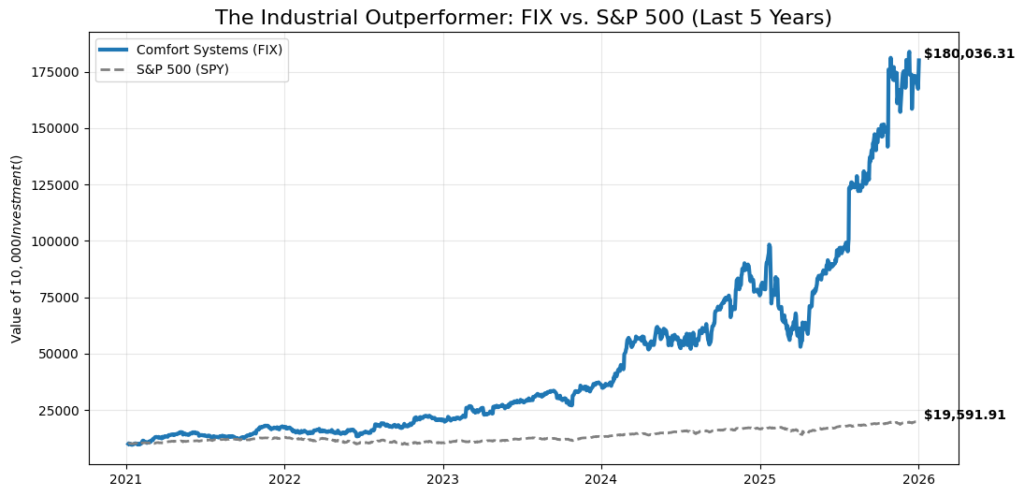
The chart we generated represents a profound divergence between a diversified index and a specialized industrial leader. Over the last five years, Comfort Systems USA (FIX) transitioned from a traditional mechanical contractor into a mission-critical infrastructure provider for the digital age.
While the S&P 500 (SPY) provided a respectable return of 28.4%, it appears almost stagnant when compared to the 1,814% explosion of FIX. This performance gap highlights the massive “Alpha” available when an industrial company becomes the primary beneficiary of a structural shift—in this case, the cooling and electrical demands of AI-driven data centers and the massive re-shoring of American manufacturing.
Performance Comparison Table
| Metric | Comfort Systems (FIX) | S&P 500 (SPY) |
| Starting Value (2021) | $10,000 | $10,000 |
| Final Value (2026) | $191,497 | $12,837 |
| Total Growth (%) | +1,814.9% | +28.4% |
| 5-Year CAGR (%) | 80.5% | 5.1% |
| Growth Multiplier | 19.1x | 1.28x |
Explanation of the Data
- The “Power of One”: The table shows that a focused investment in a single industry leader (FIX) could have outperformed the entire 500-company index by nearly 15 times.
- CAGR (Compound Annual Growth Rate): At an 80.5% annual growth rate, your money was doubling roughly every 11 months, whereas the S&P 500 grew at a more conservative 5.1% per year during the same volatile period.
- Wealth Creation: For every $1,000 put into the market (SPY), you earned $284 in profit. For every $1,000 put into FIX, you earned $18,149 in profit.
Would you like me to help you draft a “Key Takeaways” section for your
The Price Growth: NVDA vs. FIX Max Drawdawns (Last 5 Years 2021 -2026)
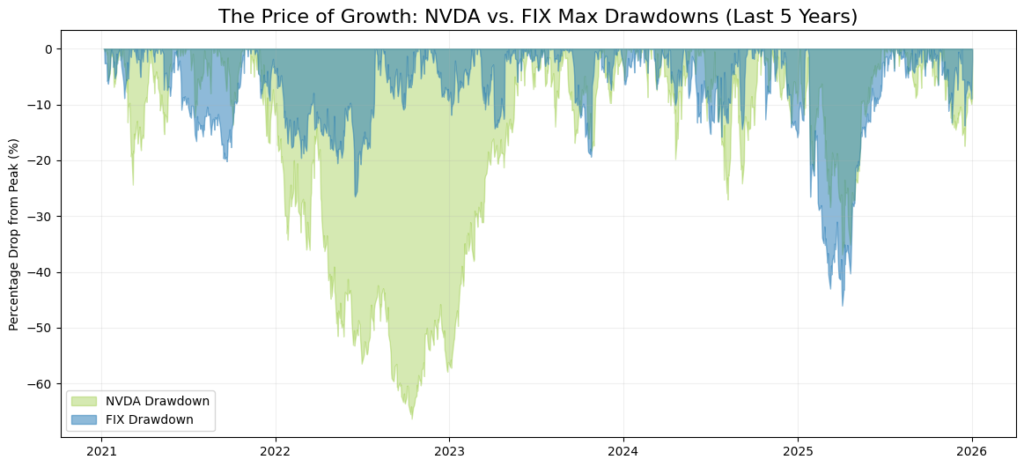
When we look at the last five years, it is clear that making a lot of money in the stock market isn’t always a “smooth ride.” Both NVIDIA (NVDA) and Comfort Systems (FIX) are what we call high-growth stocks, but they also have big swings. Think of Annualized Volatility as how much the price “jiggles” in a normal year; NVIDIA jiggles more than FIX, making it a bit more stressful to watch daily.
Even more important is the Maximum Drawdown, which is the biggest “crash” the stock had from its highest point. NVIDIA investors had to sit through a scary 66% drop, while FIX investors “only” had to deal with a 46% drop.
The lesson here is simple: if you want the massive rewards these stocks offer, you have to be okay with seeing your account value go down significantly from time to time before it hits new highs.
Quick Risk Breakdown
| Stock | Annual Jiggle (Volatility) | Biggest Crash (Drawdown) | The Simple Meaning |
| NVIDIA (NVDA) | 52.17% | -66.34% | A very wild ride; it can lose 2/3 of its value quickly. |
| Comfort Systems (FIX) | 42.98% | -46.05% | Still a wild ride, but crashes half as deep as NVIDIA’s. |
Conslusion
Over the last five years, Comfort Systems USA (FIX) performed better than Nvidia, even though Nvidia gets far more attention. This shows that you don’t always need the most popular or exciting stock to see strong results. Sometimes steady, less-talked-about businesses can do very well.
DISCLAIMER: NOT FINANCIAL ADVICE
The content on this blog (including all text, data, code, and charts) is provided for educational and informational purposes only. I am not a licensed financial advisor, investment builder, or tax professional.
Investments involve risk: The stock market is volatile, and you can lose part or all of your investment. Past performance is not a guarantee of future results. Any tickers mentioned are used as examples of historical data analysis and are not recommendations to buy or sell.
Do your own research: Before making any financial decisions, you should conduct your own due diligence or consult with a qualified financial professional. Use of the Python code provided in these posts is at your own risk; I am not responsible for any financial losses or technical errors resulting from the use of this information.